
New World Horizons
Contact Dharma

Dear Friends,
This week I finished writing the first part of my Ph.D dissertation and sent it off to my committee members. I have a wonderfully supportive and inspiring committee and love the academic work I’m now doing. The focus of my dissertation is UFO (or UAP) secrecy – which allows for profound reflection on questions of power, knowledge, and the nature of reality. Immersing in these questions entails close engagement with modern security protocols, information ecologies, and exotic technoscience. It calls for familiarity with the vast historical record of UAP contact, encompassing a diverse spectrum of intimate encounters, and sensitivity to its transformative potentials. Yet animating my pursuit of these questions is an underlying contemplation of the implications of UAP contact for basic existential and spiritual matters, and a personal reflection on the place of UAP research within my own spiritual process and life path. What bearing do UAP realities have on the core situation of existential bondage and liberation? How does UAP disclosure alter or illuminate the nature of the spiritual path? What does all of this mean for practice, moment by moment?
Much of my reflection is cultural and historical. If technologically advanced, superpowerful beings are shaping the world, and the human species has been systematically lying to itself about this for centuries, what does that imply about the relevance and trustworthiness of religious traditions? Now, Buddhism is much more than just a “religious tradition.” It contains scientific, philosophical, artistic, and technological dimensions that do not conform to any universal definition of “religion,” and it has shown itself able to adapt with great flexibility and to accommodate new and emergent conditions. Moreover, we should be wary of the very category of “religion” – a normalized modern construct that tries to fit the full range of worldly weirdness into a hegemonic template. However, the consolidated development of traditional Buddhist systems and institutions does accord with the dominant, patriarchal order of “world religions” during the last 2,500 years. More specifically, Buddhism grounds itself in a core orientation shared with other traditions that partake of this order. This is an orientation of totality driven by a logic of absolute negation and radical liberation.
Now, this is very formulaic. Anyone immersed in practice knows that the way itself calls all aspects of this orientation into question. The Heart Sutra negates everything – suffering, the path of practice, liberation – including negation itself. Liberation is inconceivable and unmappable. It’s not a thing. Only when these elements are reified does Buddhism concretize into a definable scheme of social and spiritual organization. Yet it is precisely this organizing scheme that needs examining, for this is what we reproduce when we undertake the forms and disciplines of organized Buddhist practice. As Dharma Between Worlds has explored from the beginning, not only UAP disclosure, but modernity and dharmic inquiry itself expose the insubstantiality of this scheme. Once this is recognized, the tenability and relevance of formal Buddhist (or any religious) participation immediately becomes an open question.
So what is specific about the challenge to dominant religious systems posed by UAP disclosure? One option is to view UAP disclosure as the most potent leading edge of modernization, intensifying onto-political processes of immanentization, materialization, and secularization set in motion by modernity itself. Another is to see it as basically recapitulating the left-hand paths of tantric religion and shamanism – playing out a logic of transgression and communion ritualized by some traditions, while being prohibited as demonic and dangerous by others. Both of these options lose touch with what is most important. Both ultramodernist and left-hand antinomian representatives of UAP disclosure fail to show how UAP contact manifests the way. Instead, they cling to strategies that uphold the deluded self and perpetuate egoic contraction. Manifesting the way is not about transcendence or rejection but about genuineness, liberation. Whatever vehicles of liberation modernity and transgression might provide can be integrated, rendered available, actualized, embraced. Similarly with UAP contact; its openings are not to be denied or ignored; rather, they become horizons for further manifestation. Bodhisattva activity opens, adapts, and continues.
And yet are not some forms and conditions more suited to liberation than others? Is there not a dynamic, a process, of liberation that must be supported, sustained, and cultivated through formal practice? Do not the established yogic and contemplative traditions provide blueprints for this path of cultivation? This is essentially a question of upāya, skillful means, and it has no fixed answer. Upāya is a spontaneous outgrowth and play of unbounded compassion. In a world drastically transformed by modernization and accelerating technoscientific advancement, permeated by mysterious forces and unknown agencies, liberatory means must be not only formally religious but anomalously and scientifically experimental. Ritual ecologies and mandalic collaborations must be developed that synthesize spirituality and technology, consciousness and matter. A new world is emerging through this process, and it irrepressibly will be, like this one, a buddhaworld filled with buddhas! As always, the kōan: how do buddhas practice?
That’s all for now. I want to thank you deeply for continuing to care and engage with this path! Good things will come as we keep opening and tuning in together!!
My dissertation work will be absorbing throughout the upcoming year. Great vow is what continues through it all, holds it all open.
If you express interest, I’ll share some of my more refined writings about UAP – including a recent presentation on UAP disclosure and Dōgen’s Genjōkōan. Do let me know your thoughts.
In True Love and Dharma Friendship,
Kennyō
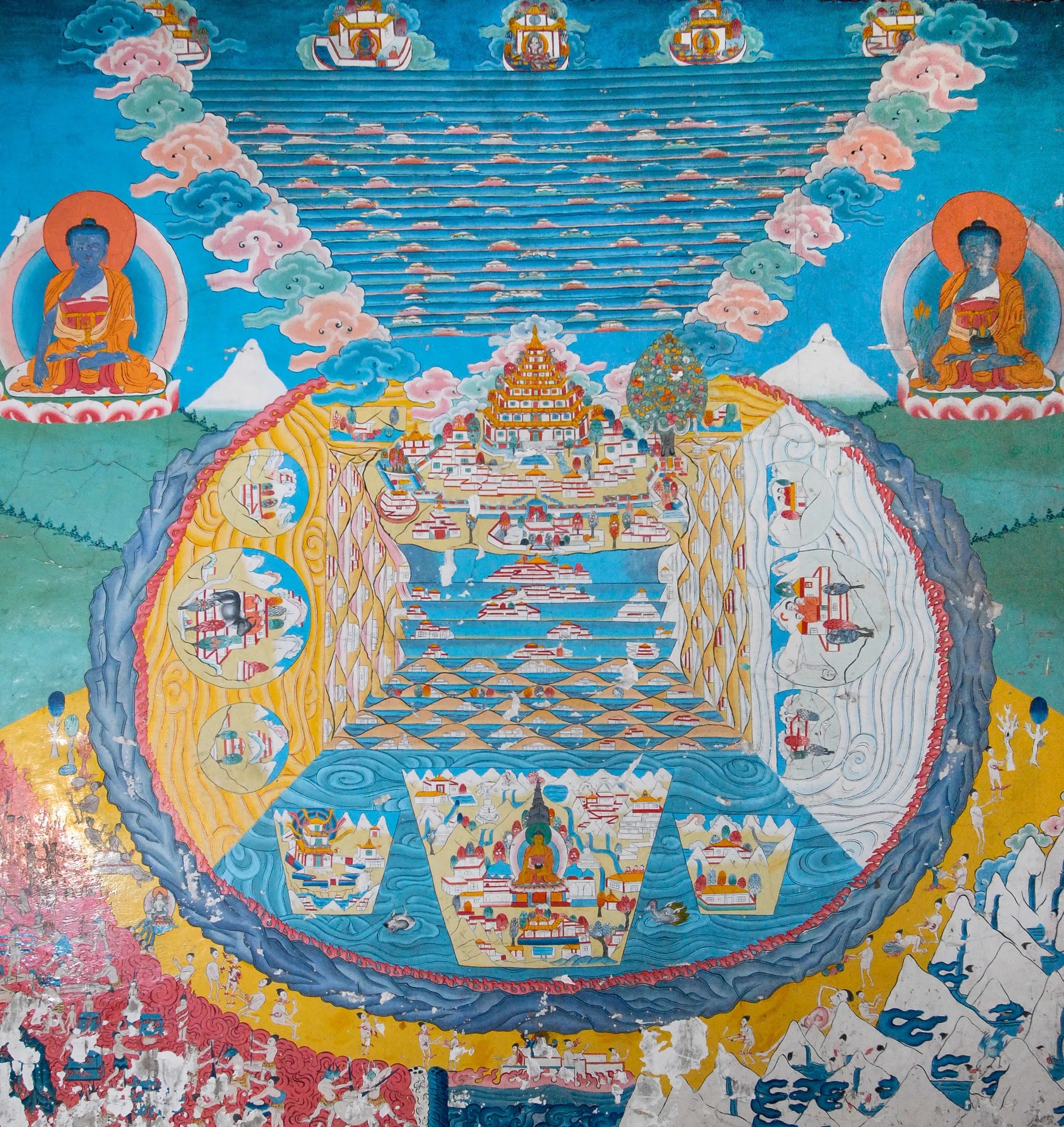
*Image: View of the Cosmos from Dorje-Ling (thanks to Eric Huntington)
Congratulations on getting through another dissertation step!